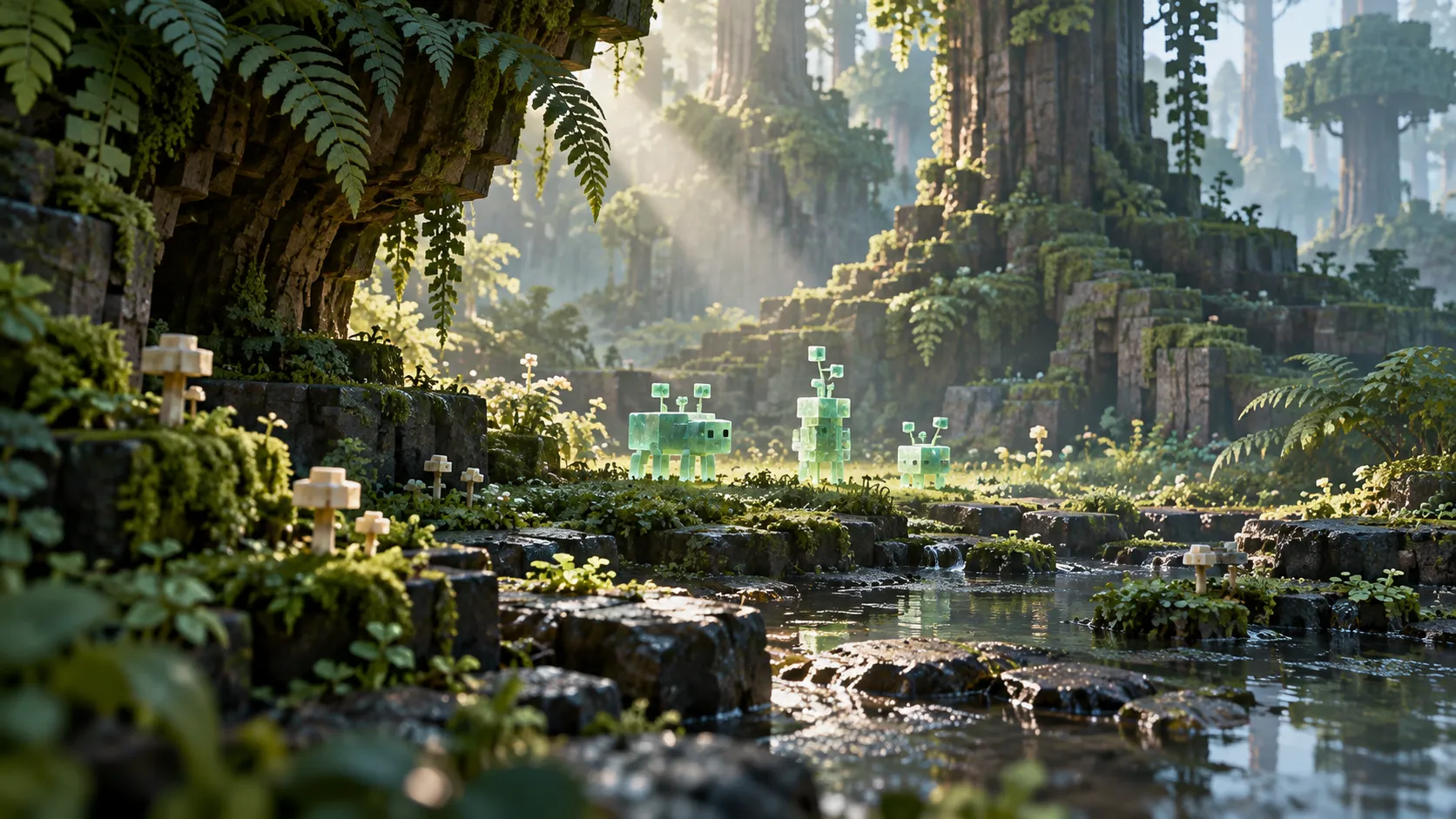
What are Minecraft Sculkers?
Sculkers are a family of hostile, sculk-related creatures native to The Sift in Minecraft Dungeons II. The five named types are Hunter, Stalker, Scavenger, Trapper and Monarch. Monarch is the boss member; the other four have individual enemy roles. Start with the action you can see—pulling, dashing, casting souls, creating barriers or commanding a boss encounter—then use the matching guide below.
The family name helps connect a group of unfamiliar creatures without treating them as one enemy with interchangeable attacks. A Hunter’s cage changes your movement differently from a Stalker’s lunge, even though both creatures have claws. When several Sift Sculkers appear together, naming those roles is more useful than trying to apply the same response to every silhouette.
Five Sculker types
| Type | Family appearance | Action or role to identify | Individual guide |
|---|---|---|---|
| Hunter | Orange-toned, clawed Sculker | Cages and pulls a hero; also has a growing shriek projectile | Hunter: cage, pull and pounce |
| Stalker | Blue-toned, clawed Sculker | Claw attacks, a spinning dash and a spectral afterimage | Stalker: melee sequence |
| Scavenger | Yellow-toned, magical Sculker | Tracking soul projectiles, lingering soul fire and a backward dodge | Scavenger: ranged sequence |
| Trapper | Pink-toned, clawed Sculker | Conjures magical barriers around heroes | Trapper: barrier identification |
| Monarch | Huge Sculker with long claws | Boss encounter with arm-cued attacks, summons and a spectral Echo | Monarch: boss cues |
The appearance descriptions come from the family record. Use them alongside the action rather than as a color-only test: lighting, spell effects and overlapping enemies can obscure a creature. The individual guides explain complete sequences and retain the separate entity sources for each attack.
Identify the enemy that changes your movement
If your hero becomes enclosed and is drawn toward the attacker by chains, start with Hunter. Its sequence continues from cage to pull and then a pounce. If a new barrier surrounds you, compare Trapper and trace the cast back to the creature that produced it. The Hunter’s chain pull provides a useful distinction when the initial enclosure looks similar.
For an attacker moving its own body toward you, look at Stalker. Its claws and advancing dash make the enemy close the gap. A Scavenger moves the other way when approached, creating distance after casting its soul projectiles. Watching which participant moves, and in which direction, helps separate these three roles in a crowded encounter.
Identify the boss rather than an ordinary family member
Monarch is the large boss, not a collective label for all five creatures. Its individual guide follows right-arm, left-arm and both-arm cues, delayed feather projectiles and the Monarch Echo. Seeing a smaller Sculker beside it identifies a supporting enemy with its own attacks. Keep the original boss, the spectral copy and the summoned enemies separate as you follow the fight.
Sculker nests in Humbler Huskland
The family record places Sculkers in the ravines of Humbler Huskland, where they live in nests under a Monarch’s rule. The Carapace region guide describes the blue stone, sandy terrain, ravines and enormous humbler husks associated with that setting. Those landmarks give you regional context when a quest or creature guide points into a nest.
Wrath of the Sculkers is the named quest associated with a Sculker nest. Use the quest guide for your current objective and the Monarch guide when it leads to the boss. A family habitat is not a fixed coordinate: follow the destination shown in your game, then identify the enemy you encounter by its own action.
The published location sources currently describe Carapace and Humbler Huskland at different levels. The individual Carapace page treats the names as aliases, while the location directory lists The Carapace beneath Humbler Huskland. The region guide keeps both source contexts together. For navigation, preserve the exact label on your map or objective rather than replacing every mention with one name.
Sculkers, Sifters and Tuners
The Sift Sculkers share their surroundings with other native creatures. Their family lore describes territorial behavior, suggests that they hunt Sifters, and associates them with keeping Tuners nearby while bathing in Ichor. Illagers harvesting Ichor and capturing Tuners disturb that setting and draw Sculkers out from their nests.
This relationship helps explain a scene without giving every participant the same enemy identity. A Sifter is its own creature, while a Tuner has a separate role. Neither becomes a sixth Sculker type because it appears near a nest. Use the family table to identify a Sculker, then the individual creature pages to understand its neighbors.
The same distinction matters at an Ichor pool. Native creatures bathing or moving in the liquid do not establish a safe path for a hero. The Ichor Pools record says contact depletes a hero’s souls and specifically identifies Blubs and some other mobs as unaffected. Read the liquid as an environmental interaction alongside the creatures around it.
Sculkers and Warden: choose the correct creature and game
Warden is not one of the five types listed in the Sculker family record. Shared sculk associations or a similar visual feature are not enough to assign Hunter’s pull, Trapper’s barriers or Monarch’s attacks to Warden. If you are comparing their appearance, first name the individual Sculker; “Sculker” can refer to several different bodies and roles.
These creature guides cover Minecraft Dungeons II. A question about when The Sift reaches vanilla Java or Bedrock belongs to the separate release-date guide. A Dungeons II family entry does not supply a Java spawn rule, a Bedrock summon command or confirmation that every individual creature transfers unchanged. Keep the game identity attached when choosing instructions.
Recognize the names on equipment
The family also gives names and visual themes to equipment. Sculker Armor includes Mask, Robe, Slacks and Boots; Monarch Armor uses Crown, Mantle, Sash and Talons. The Sculker Armor comparison handles those slots and their effects. A gear name answers which equipment you have, while the creature page answers which enemy you are fighting.
For a quick next step, choose the problem in front of you: use the table for an unfamiliar enemy, the region guide for a ravine or husk destination, the Monarch guide for boss cues, and the armor comparison for an inventory item.
Sources
Family membership, appearance and nest relationships follow Minecraft Wiki’s Sculker record, revision 3815962. Regional context follows The Carapace, revision 3815925 and Location, revision 3816050. Hunter’s expanded action sequence follows revision 3816422; the other combat summaries link to the sourced individual guides above. These records were checked October 3, 2026.